Serve a modern API reference in Symfony with Scalar
Update, 18 Sep 2026: the bundle was adopted into the Scalar organization and is now the official Symfony integration — github.com/scalar/symfony, published on Packagist as scalar/symfony. That is the package to install: composer require scalar/symfony. The former alex-frolov/scalar-symfony package is marked abandoned, and its repository is archived. The article below tells how the bundle was built; the installation commands in it now point at the official package.
1. OpenAPI in real projects
Working with PHP, you constantly face the need to keep your documentation up to date. Most modern PHP projects are API-first: the backend is PHP, and the frontend is built separately.
That leaves two paths:
- Spec-first — first you write a specification of all possible routes with input/output parameters, errors, and so on. Often that's a YAML OpenAPI file;
- the OpenAPI file is generated from attributes and annotations in the code.
In the first case, you implement what the spec says and can verify that everything matches. In the second, the schema is always current (after an automatic regeneration).
The de-facto standard in Symfony is NelmioApiDocBundle. Up to version 4 it still shipped Swagger UI or Redoc as the UI. If you look for other UI options, you find Scalar — a fresh, modern, open-source API Reference renderer (support is announced in NelmioApiDocBundle 5+). But NelmioApiDocBundle generates OpenAPI from attributes — it's the reference representative of the second type.
A look at the competition — Laravel — shows more variety there: Scribe, Scramble, and an official Scalar integration.
What I wanted was a lightweight, modern UI for rendering a ready-made OpenAPI YAML file — for working with API docs the spec-first way. And Scalar seems perfect for that. Except there is no out-of-the-box integration for Symfony. To get Scalar into a Symfony project, you had to copy an HTML page with a <script> tag from the Scalar docs and wire the configuration yourself.
Scalar's own official integration list covers 30+ frameworks (Express, FastAPI, NestJS, Spring Boot, Laravel) — but no Symfony. And there was not a single package on Packagist that plugged Scalar into Symfony.
In one of my projects I follow the OpenAPI-first approach: spec first, implementation second. I didn't want to drag the heavyweight NelmioApiDocBundle into the project. The choice fell on Scalar. One thing was wrong: no integration. I could have integrated it in-project by hand, but I realized it could be packaged as a bundle and reused in other projects. In one evening I wrote the first version of the Symfony bundle, the tests and the CI matrix. I tested it on my own project — and then published it.
2. A closer look at what Scalar is
Scalar is an open-source API platform for working with OpenAPI documents.
Two parts:
- API Reference — an interactive renderer for OpenAPI 3.x; loads the spec client-side, with a built-in API client (the ability to run test requests), code snippets in different languages (curl, PHP, Python, Go), various themes and auth schemes;
- API client — a Postman-class desktop app that works offline and reads the same OpenAPI files.
As of now on GitHub: about 16,000 stars, created in 2023, more than 100 releases — an actively maintained project.
There is an integration for Laravel (scalar/laravel, official, in the scalar org) — and that's the reference to look at when building your own bundle. What does it do? A "thin package" that serves a single page with Scalar, pointed at any OpenAPI document.
3. The bundle: what it does
scalar/symfony renders the Scalar API Reference in Symfony from any OpenAPI document. One route, no coupling to how the spec was generated: it can be a static openapi.yaml, swagger-php, NelmioApiDocBundle or API Platform.
To install and configure it you edit two files.
Add the bundle:
composer require scalar/symfonyEdit the settings:
# config/packages/scalar_symfony.yaml
scalar_symfony:
    url: '/openapi.yaml'          # your OpenAPI document (required)

    path: '/scalar'               # route (default: /scalar)
    cdn: 'https://cdn.jsdelivr.net/npm/@scalar/api-reference@1.65.1'

    configuration:
        theme: 'default'
        metaData:
            title: 'API Reference'

    scalar_options:               # any Scalar option, passed through as is
        darkMode: false
        layout: 'modern'

    access_control:
        mode: public              # or 'attribute' + security attribute
# config/routes.yaml
scalar_symfony:
resource: '@ScalarSymfonyBundle/config/routes.php'That's it — the reference is available at /scalar. The page is a small HTML document with the CDN script and Scalar.createApiReference('#scalar-api-reference', {...}), with the config serialized XSS-safely (JSON_HEX_TAG/APOS/AMP/QUOT).
4. A real request, a real 201
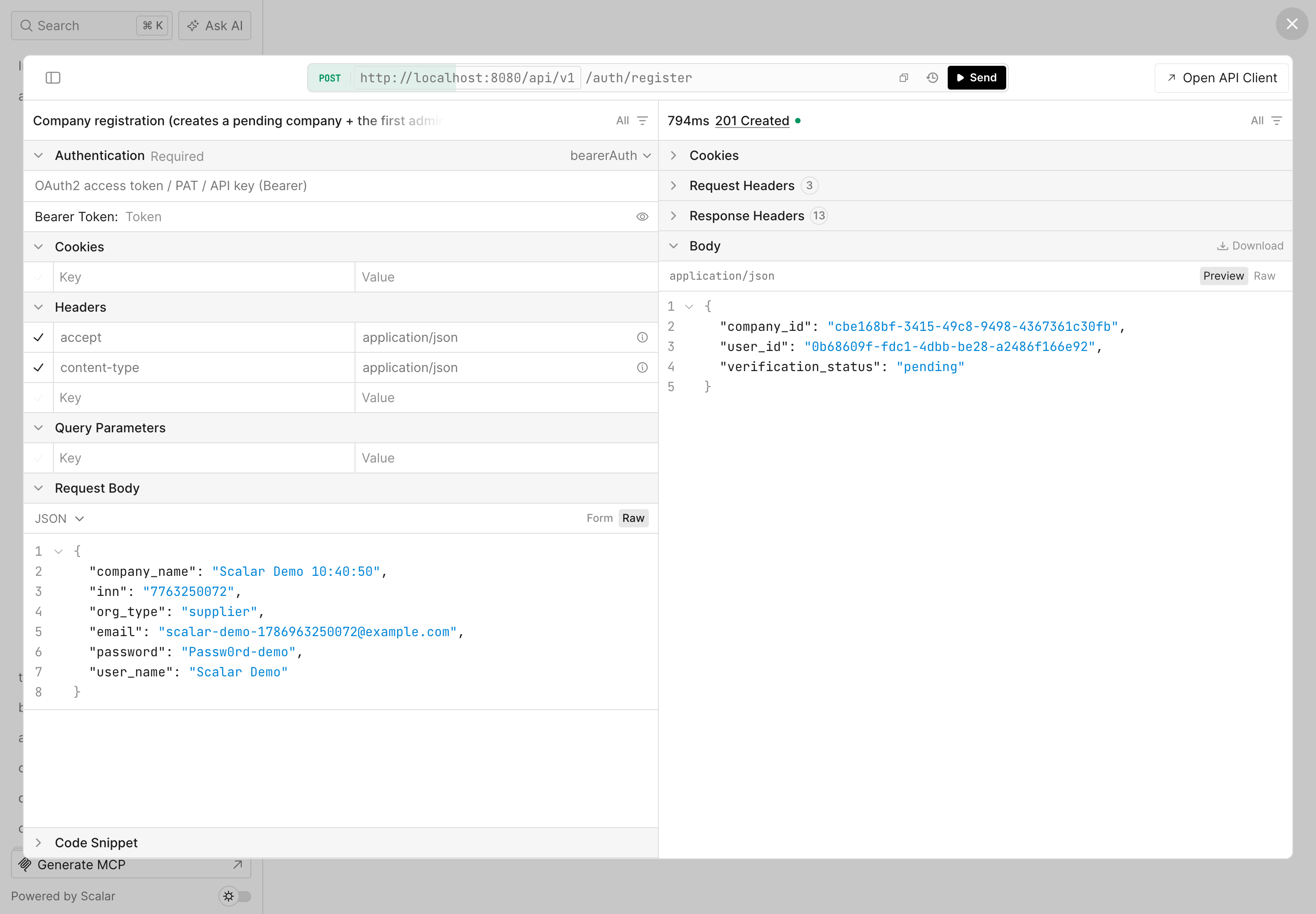
The best way to show this is a live example, not a mockup. The bundle serves the API reference of the Tender Platform (Symfony 8.1, highload auction API; the spec is OpenAPI 3.1). Through "Test Request" I opened the POST /auth/register endpoint — "Company registration (creates a pending company + the first admin user)" — filled the JSON body, hit Send, and got:
HTTP/1.1 201 Created  (794 ms)
{
  "company_id": "0c7702c6-9667-4ea3-8caa-df4990522ee7",
  "user_id": "86a40d70-5ef9-44fd-882b-8f703e10df7e",
  "verification_status": "pending"
}
A real response with real data. There are more ways to exercise an endpoint here than Swagger UI offers: the page works as an interactive client.
5. Quality bar
The final state:
- 16 functional tests, 46 assertions;
- static analysis — PHPStan level max;
- code style — PHP-CS-Fixer, the
@Symfonyrules; - CI checks: PHP 8.2/8.3/8.5 with Symfony 6.4/7.2/7.4/8.0, including the
--prefer-lowestoption (5 jobs), a no-dev smoke test andcomposer validate --strict; - security hardening in the config: compile-time validation added —
attributemode without Symfony Security failscache:clearwith a clear error instead of an HTTP 500 on the first request; emptycdn, a path without a leading/, an emptyattribute— everything is now blocked at the config level; - security documentation added, including SRI (SHA-384 for the pinned CDN file), CSP/nonce recommendations, and a self-hosting recipe.
Two artifacts turned up along the way.
First: PHPUnit 11.5 flags tests as risky when Symfony's ErrorHandler outlives a kernel boot — fixed by restoring the exception handler in tearDown().
Second: the container is cached by kernel class and environment, which is why functional tests with different bundle configs must use a unique cache-dir per config — otherwise tests run against a stale container with broken state.
6. CI and problems
After the push to the GitHub repository, CI started. Half of the GitHub Actions jobs began to fail with a random error:
Your github oauth token for github.com contains invalid charactersAs it turned out, the cause was setup-php: it writes the Actions GITHUB_TOKEN (prefixed ghs_) into composer's global auth.json, and Composer 2.8 only accepts ghp_/gho_/github_pat_ tokens. The failures were flaky — they depended on whether the rate limit actually forced composer to use the token, so a part of the jobs passed. Even composer config --unset failed with the same error. The fix: delete auth.json on the virtual runner before the composer validate --no-check-publish check, and keep the token for dependency installation, where it protects against the rate limit.
7. Roadmap and the proposal
I opened a proposal in the Scalar organization:
Discussion #9920 — "Proposal: official Symfony integration (scalar/symfony)"
github.com/scalar/scalar/discussions/9920
The gist: adopt the bundle into the scalar org as scalar/symfony, following exactly the scalar/laravel path — transfer or fork, add the _integration: symfony tracking, list Symfony in the official integrations. The bundle is published, tested, and running in production — the adoption effort is almost zero, and Symfony developers get what Laravel already has.
The discussion collected 38 upvotes. On 18 September 2026 the Scalar maintainers moved the bundle into the organization: the scalar/symfony repository, the scalar/symfony package on Packagist, with authorship kept in composer.json. One month passed between the proposal and the adoption.
8. How to start using it
composer require scalar/symfony- Point
scalar_symfony.urlat any OpenAPI document (or generate one with NelmioApiDocBundle / swagger-php) - Import the routes, open
/scalar
The README covers everything in detail.
9. Summary
Scalar had no official Symfony integration; there was a need, and the bundle was built.
- The official
scalar/symfonyintegration (the bundle started out asalex-frolov/scalar-symfonyv0.1.0); - Supported versions: PHP >= 8.2, Symfony 6.4 / 7.2+ / 8.x;
- Used on the Tender Platform.
Code: github.com/scalar/symfony, MIT. How it was adopted: discussion #9920.